Overrun And Alone: The Medal Of Honor Hero Who Gave His Life For His Men
The night of September 4, 1950, was foggy and dark near the South Korean town of Waegwan. An enemy battalion had crept to within a few yards of Master Sergeant Mike Pena’s platoon without anyone hearing a single footstep. When the shooting started, it started all at once, from almost point-blank range.
What happened in the hours that followed is the story of a soldier who saved his men by staying behind. This is his story.
The Man Behind The Uniform
Michael Castaneda Pena was born on November 6, 1924, in Newgulf, a small Texas town near Corpus Christi. He never finished the sixth grade. At 16, he lied about his age, convinced his mother to sign a release, and walked into a recruiting office. That was 1940. Most teenagers that age are thinking about school dances. Mike Pena was thinking about serving.
He spent World War II in the Pacific. He helped liberate the Philippines. He was wounded twice. After Japan surrendered, he stayed for the occupation of Japan rather than racing home. By 1950, he had married, settled into his rank, and was serving as a master sergeant in Company F, 2nd Battalion, 5th Cavalry Regiment, 1st Cavalry Division.
His brother Alfredo once explained to a local reporter why Mike never chased a commission: “One time they offered to make him a lieutenant, but he didn’t want it. He liked the action, the excitement, and being with his men.”
That single sentence explains everything about the decision he would make on the night of September 4.
Korea, 1950: A War Nobody Saw Coming
On June 25, 1950, North Korean forces crossed the border into South Korea and swept south with terrifying speed. Seoul fell within days. United Nations forces scrambled, but by mid-August the communists had pushed American and South Korean troops into a desperate defensive pocket around the southern port of Pusan. Every mile of that perimeter represented a line that could not be given up.
The 5th Cavalry was part of the force holding that line.
On September 1, the North Korean People’s Army sent four full divisions against the 1st Cavalry Division and the 1st Republic of Korea Division along a 35-mile front. It was their biggest push yet. They were throwing everything at the perimeter in hopes of cracking it before outside help arrived. Soldiers like Mike Pena were the only thing standing in the way.
The Night Near Waegwan
At approximately 11 p.m. on September 4, under the cover of darkness and a heavy mist rolling across the terrain, an entire enemy battalion closed to within just a few yards of Pena’s platoon before they were spotted.
The two sides were practically on top of each other.
Pena and his men opened fire immediately, but the sudden attack at such close range was overwhelming. The friendly troops were forced to pull back. Most soldiers in that situation regroup and wait for orders. Pena did not wait. He reorganized his men on the spot, then led them in a counterattack. They pushed back. They reclaimed the ground they had just lost.
But the North Korean force was far larger than his platoon, and wave after wave kept coming. Ammunition was running out fast. Pena understood exactly what that meant. With his men running dry and the position growing impossible to defend, he gave the order to fall back.
Then he took a machine gun and covered the withdrawal himself.
He held that position alone through the early morning hours, one man with a machine gun against a battalion. His position was finally overrun before dawn. He was killed. When daylight came, soldiers found his body still in the field.
He was 25 years old.
What Those Hours Actually Saved
The men of Company F survived because Pena bought them time. There is no cleaner way to say it.
Two weeks later, on September 15, General Douglas MacArthur’s forces landed at Inchon, catching the overextended North Korean army completely off guard from the flank. The following day, UN forces broke out of the Pusan Perimeter and pushed north. The tide of the Korean War reversed almost overnight.
The 1st Cavalry Division paid heavily for those weeks of fighting. By the time British Commonwealth forces arrived to relieve part of the line, the division had suffered 770 soldiers killed, more than 2,600 wounded, and 62 taken prisoner. The men Mike Pena protected that night were part of a unit that went on to fight those battles and make it home.
He did not get to go home.
A Debt That Took Decades To Repay
For his actions that night, Mike Pena was posthumously awarded the Distinguished Service Cross, the nation’s second-highest military honor. For 64 years, that is where it stood.
In 2002, Congress directed the military to review records of Hispanic American and Jewish American service members from World War II, the Korean War, and the Vietnam War to determine whether racial bias had affected how awards were distributed. The review, which took 12 years, identified 24 soldiers whose Distinguished Service Crosses should have been Medals of Honor from the start. Mike Pena was one of them. The group became known as the “Valor 24.”
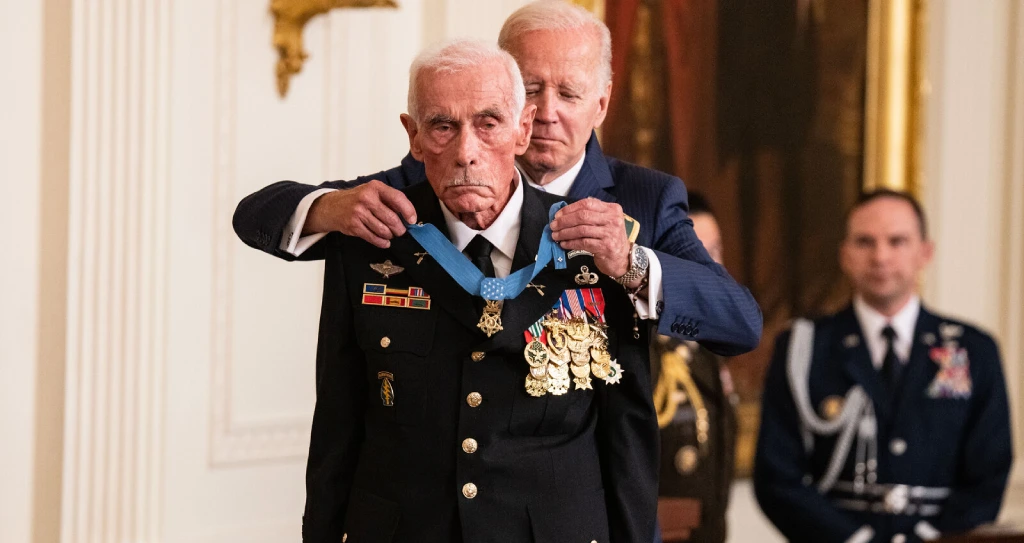
On March 18, 2014, President Barack Obama presented the Medal of Honor at the White House. Mike Pena’s son, Michael David Pena, accepted it on his father’s behalf.
Michael David Pena had been only three years old when his father died in Korea. He had spent his entire life knowing who his father was through the stories of others. When the White House called to tell him about the upgrade, he later recalled that the caller asked if he had a minute to speak with the president. His response was simple: what was he going to say, that he had to go to the store?
He told President Obama that he had always been proud of his dad, and that being his son was already an honor. He also said something that puts the whole story in a quiet, human frame. He had always hoped his father’s sacrifice meant that other kids got to grow up with their own fathers.
That is what the ultimate sacrifice in war actually looks like from the other side of it.
The Legacy That Carries Forward
Mike Pena is one of more than 3,500 recipients of the Medal of Honor since the decoration was established during the Civil War. He is part of a long line of soldiers who gave everything for the person beside them, often with no witnesses, no guarantee of recognition, and no time to think it over.
Stories like his matter because they are true, and because they are specific. Not just “a soldier gave his life.” This soldier. This night. This mist. This machine gun. This son who spent 64 years waiting for a phone call from the president.
The same spirit that drove Mike Pena shows up across generations and conflicts. If this kind of story stays with you, the account of SSG Matthew Ammerman on Veteran Diaries carries that same weight and deserves to be read alongside it.
A Name Worth Remembering
The word “hero” sometimes feels worn out. Mike Pena sharpens it back up.
He did not chase rank. He did not want a commission. He wanted to be with his men, and when the moment came, he stayed with them in the most permanent way possible. He covered their retreat until there was nothing left to cover it with.
That is what this military hero story is. Not legend. Fact. Documented, verified, and finally recognized with the medal it deserved more than six decades after the mist cleared over Waegwan.For more stories of soldiers whose courage carried others forward, visit Veteran Diaries and keep reading. These names deserve to stay alive.
Leave a Comment