Best Tactical Boots For Veterans In 2026: Rocky, Salomon FORCES, Danner Tested
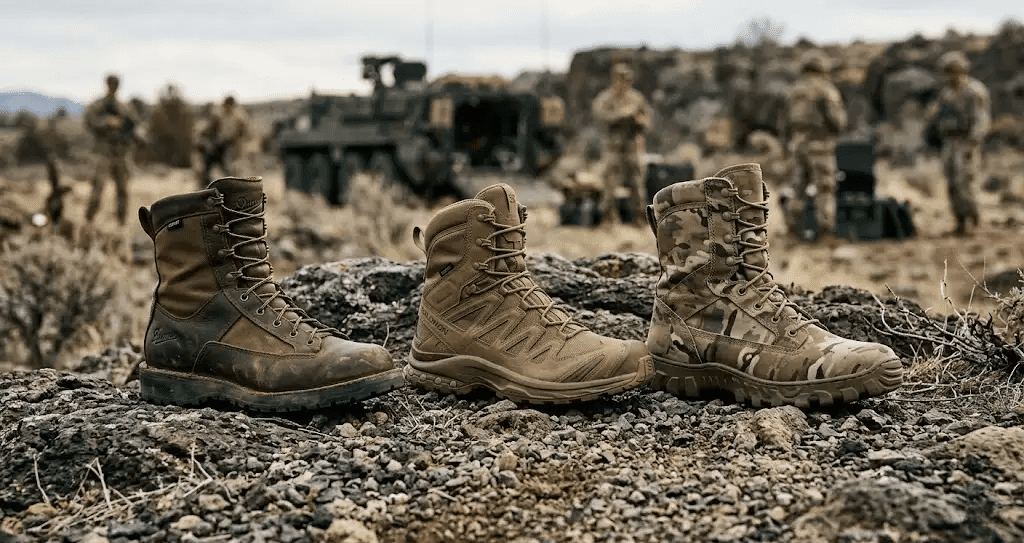
We put three of the most talked-about boots through four months of real use. Here’s what we found.
Boot opinions in the veteran community are like political opinions everyone has one, nobody agrees, and someone always gets heated. Which is understandable. A bad boot decision doesn’t just cost you money. It costs you blisters, knee problems, and if you’re unlucky, something worse.
So when we set out to compare Rocky, Salomon FORCES, and Danner head-to-head, the goal wasn’t to produce a ranking. It was to answer a more useful question: which boot is right for which person. Because the honest answer is that all three are legitimate and all three are wrong for somebody.
Four months. Multiple testers. Different missions and environments. Here’s what we found.
Rocky S2V Tactical Military Boot
Best for: Veterans who want proven military heritage at a reasonable price point
Rocky has been making military footwear long enough that their boots have seen actual deployments not just range days and trade shows. The S2V specifically was developed with special operations input, and that lineage shows in the construction.
The fit is traditional structured, supportive, and built for people who expect a boot to feel like a boot. Break-in time is real: plan on two to three weeks before these feel natural. That’s not a flaw for a boot at this build level, but it’s worth knowing before you order them for an event happening next weekend.
Where the S2V earns its reputation is durability and foot protection. The sole is aggressive and performs well on varied terrain. The upper holds up under hard use without showing premature wear. For veterans who spend time in the field, on construction sites, or anywhere that demands genuine protection over long days the Rocky delivers.
What we didn’t love: The weight. These are not light boots. Coming from a military background that’s probably fine you’re used to it. Coming from a trail running background, you’ll feel the difference immediately.
Verdict: Reliable, proven, and priced fairly for what you get. Buy them if durability and foot protection matter more than weight and agility.
Salomon FORCES X Ultra Mid GTX
Best for: Veterans who want trail performance with tactical functionality
Trail running and mountaineering helped Salomon establish their name, and they carried that DNA with them when they created the FORCES brand for law enforcement and the military. The end product is lighter, more nimble, and noticeably better at moving quickly over a variety of terrain than typical tactical boots.
Out of the box, these fit like running shoes. No meaningful break-in period. For veterans transitioning to more active civilian lifestyles trail running, hiking, fast-paced outdoor work that immediate comfort is a significant advantage.
Unlike some waterproof boots, the Gore-Tex interior keeps feet dry in bad weather without making them more rigid. The Contagrip sole from Salomon’s trail running line is effective on a variety of conditions, including wet rock and loose soil.
What we didn’t love: They’re not built for the same punishment as the Rocky or Danner. Under sustained hard use heavy loads, rough terrain over many months they show wear faster. They are also not the ideal choice if you want substantial ankle support because the design prioritizes mobility over maximal lateral stability.
Conclusion: The ideal choice for veterans who value comfort and mobility over maximal durability. Outstanding for hiking, active daily use, and light tactical work. Not the answer for high-load field environments.
Danner Tachyon
Ideal for: Veterans who are prepared to pay for the best of both worlds
Since 1932, Danner has been producing boots in Portland.Their craftsmanship reputation is not marketing it’s earned. The Tachyon is their answer to the lightweight tactical market, and it’s arguably the most well-rounded boot in this comparison.
Where the Rocky is heavy and the Salomon sacrifices some durability for agility, the Tachyon finds a middle ground that neither quite achieves. You stop thinking about it after an hour of standing because it is light enough. It does not age too quickly because of its superb structure. The fit finds a middle ground between the softness of a trail runner and the stiff feel of a traditional boot.
The sole performs well across environments not as aggressive as the Rocky on rough terrain, not as specialized as the Salomon on trails, but genuinely capable across both. For veterans whose days shift between urban, suburban, and light outdoor environments, that versatility matters.
What we didn’t love: The price. The Tachyon costs more than the Rocky and the Salomon. For what you get, it’s justified but it’s still a real number, and budget is a real consideration.
Conclusion: In this comparison, this boot is the best overall. It is the one we would most generally recommend if the price is reasonable.
How To Actually Choose
Forget the rankings for a second and ask yourself three questions.
What’s your primary environment? Hard field use with heavy loads Rocky. Trails, hiking, fast movement Salomon. Mixed daily use across environments Danner.
How much does weight matter to you? If you’ve spent years in heavy boots and it doesn’t bother you the Rocky’s weight is a non-issue. If you’re coming back from a lower-body injury and every ounce matters Salomon or Danner.
What’s your budget ceiling? Rocky is the most affordable. Salomon sits in the middle. Danner costs the most. All three are worth what they charge but that only matters if the price point works for you.
One Thing All Three Taught Us
No boot regardless of brand, price, or marketin fixes a fit problem. All three of these boots are available in wide widths, and if you’ve spent years in military-issued footwear that never quite fit right, getting properly measured before you buy anything is the most valuable step you can take.
A great boot that doesn’t fit is just an expensive blister.
All boots were purchased at retail and tested over four months across range days, trail use, and daily carry.

Leave a Comment