Tritium vs Super-LumiNova: Which Lume Technology Is Actually Better For Tactical Use?
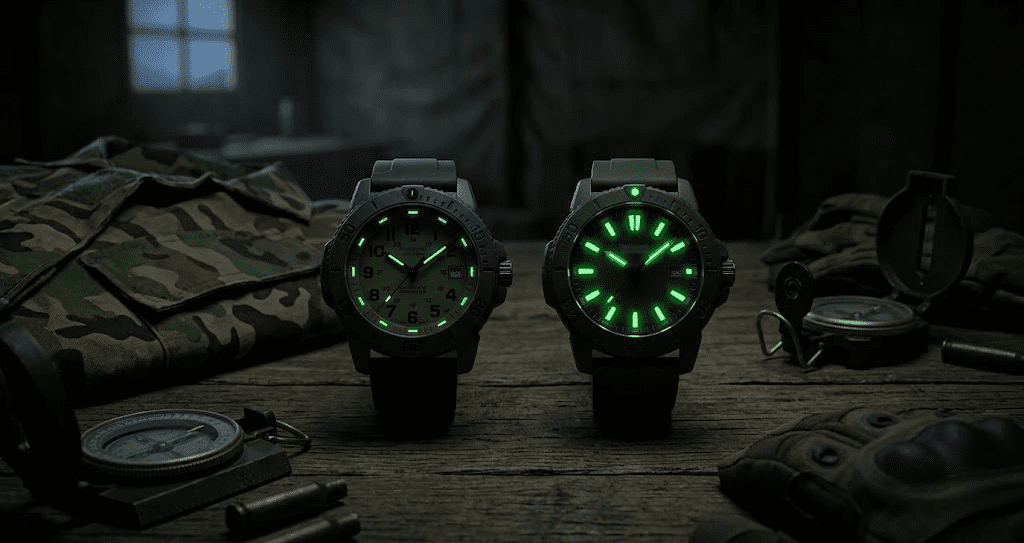
Glancing at your watch in total darkness shouldn’t require a flashlight.Tritium vs Super-LumiNova is one of the most debated topics among people who rely on their watches in low-light environments.Moreover both technologies solve the same problem in completely different ways. Here’s how they actually stack up when it matters.
How Each Technology Actually Works
Super-LumiNova is a photoluminescent material. Therefore, it absorbs light energy during the day and slowly releases it as a glow at night. However, that glow fades over several hours, and it needs light exposure to “charge” in the first place.
Tritium on the other hand works completely differently.It uses small gas-filled tubes that emit constant light through radioactive decay. As a result, tritium never needs charging and glows at a steady brightness for years.
The Self-Powered Advantage
This is tritium’s biggest selling point. Additionally, because it doesn’t rely on stored light, tritium performs identically whether you’ve been in a dark bunker for days or standing in direct sunlight. Furthermore, the glow stays consistent night after night without any drop-off.
Tritium vs Super-LumiNova: Brightness And Longevity
Fresh Super-LumiNova actually outperforms tritium in peak brightness. In fact, immediately after sun exposure, a quality Super-LumiNova dial glows noticeably brighter than tritium tubes.
However, that brightness fades fast usually within 4 to 8 hours, depending on the grade used. Moreover, by early morning, most Super-LumiNova watches have faded to barely visible.
Tritium’s Steady Glow
Tritium tubes maintain a dim consistent glow for 10 to 12 years before the gas naturally decays.Therefore if you’re checking the time at 3 a.m. every night for years tritium never lets you down.That said, the glow is noticeably dimmer than fresh Super-LumiNova it’s a tradeoff between brightness and consistency.
Real-World Tactical Use Cases
For night operations, consistency often matters more than peak brightness. Beyond that, tritium watches don’t require you to remember sun exposure before heading into the field the glow is simply always there.
However Super-LumiNova has its own tactical advantage.For example, after a full day outdoors, a quality lume coating can briefly outshine tritium during the first hour of darkness useful for quick map checks right after sunset.
Safety And Regulations
Tritium tubes contain a radioactive isotope, though the radiation level is extremely low and considered safe for wear. Additionally, some countries restrict tritium watch imports due to regulatory concerns, while Super-LumiNova faces no such restrictions anywhere.
Cost And Maintenance Differences
Tritium tubes add manufacturing cost, so watches using this technology tend to sit at higher price points. Furthermore, when the tubes eventually dim after a decade, replacement requires a watchmaker not a simple fix.
Super-LumiNova, however, costs less to apply and never needs replacing, since it’s part of the dial finish itself. Overall, this makes Super-LumiNova watches generally more affordable and easier to maintain long-term.
Final Thoughts
So, in the Tritium vs Super-LumiNova debate, the better choice depends entirely on your use case. Therefore, if you need guaranteed visibility throughout the night without thinking about charging, tritium wins outright.
Moreover, if your routine involves regular daylight exposure and you want maximum brightness right after dark, Super-LumiNova delivers excellent short-term performance. In fact, many tactical users end up owning one watch with each technology for different situations. Either way, both options outperform a standard watch with no lume at all.


Leave a Comment