Master Sergeant Roddie Edmonds: The POW Who Stood Between His Jewish Soldiers And The Nazis
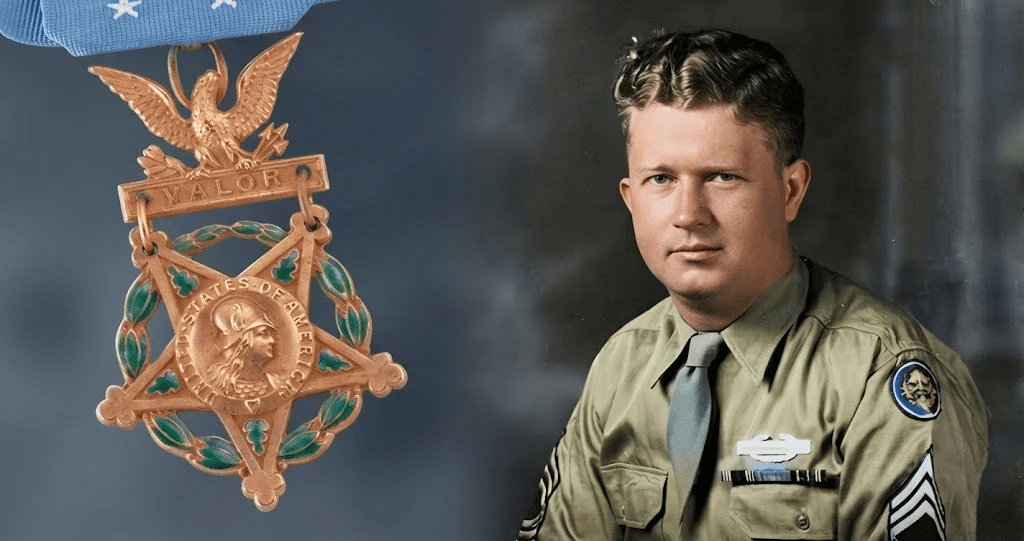
Most soldiers are remembered for the battles they fought on the field. Roddie Edmonds is remembered for the battle he fought standing completely still. No weapon. No backup. Just a man, a freezing German POW camp, and a choice that most people would never have the courage to make. He did not know if he would survive that morning. He stepped forward anyway.
A Winter That Broke Armies
The German offensive that tore through the Ardennes Forest in December 1944 caught Allied forces completely off guard. Thousands of American soldiers were surrounded, cut off, and taken prisoner. Among them was Master Sergeant Roddie Edmonds, a 26-year-old soldier from Knoxville, Tennessee, assigned to the 422nd Infantry Regiment of the 106th Infantry Division.
He was transferred to Stalag IX-A, a German prisoner-of-war camp near Ziegenhain. Cold, overcrowded, and controlled by men who had long stopped following rules, the camp was a place where rank meant little, unless you decided to make it mean everything.
Edmonds was the highest-ranking American NCO inside those walls. He was about to use that position in a way no military manual could have ever prepared him for.
The Order That Was Never Meant To Be Followed Quietly
One morning in January 1945, the German commandant issued a direct order: all Jewish American prisoners were to step forward and identify themselves separately at the next morning’s roll call.
The intent behind that order needed no explanation. Jewish soldiers pulled from the general prisoner population faced an entirely different fate: deportation, forced labor, or worse. The SS had a very particular interest in what happened to them.
Edmonds did not argue. He did not try to hide a handful of men in the barracks and hope no one noticed. He gave a counter-order, one that was simple, impossible to misunderstand, and dangerous to deliver.
Every American prisoner, all 1,290 of them, would stand together at roll call the next morning.
And they did.
We Are All Jews Here”: Four Words That Defied A Pistol
When the German commandant stepped out to face the assembled prisoners and demanded only the Jewish soldiers step forward, he found something that had no place in his worldview: an entire American formation standing as one, nobody separating, nobody flinching.
Edmonds stood at the front and said, plainly and without hesitation: “We are all Jews here.”
The commandant raised his pistol and pressed it against Edmonds’ head.
He did not move.
Instead, he reminded the commandant that the Geneva Convention still applied to prisoners of war. He told him, directly, that Germany was already losing the war and that any officer who ordered a massacre of POWs would face a war crimes tribunal when it was over. And then he said something that left no room for negotiation: if the commandant wanted the Jewish soldiers, he would have to shoot every single man standing before him.
The commandant lowered the gun. He walked away.
Roughly 200 Jewish American soldiers went home because of what happened in those few minutes.
The Quiet Life Of A Man Who Never Told His Own Story
What followed was, by most accounts, an ordinary American life. Edmonds returned to Knoxville after the war, raised his family, went to church, and lived without fanfare. He never published a memoir. He never sought out journalists. He did not speak publicly about what he had done.
His son, Reverend Chris Edmonds, only pieced the story together decades later, not from his father, but from the men whose lives he had saved. Survivors like Lester Tanner tracked down the Edmonds family to say something that no military citation could capture: “Your father saved my life.”
Roddie Edmonds passed away in 1985. The full weight of what he had done in that POW camp would not be widely known for another thirty years.
What A Holocaust Honor And A Presidential Recognition Still Cannot Fully Capture
In 2015, Yad Vashem, Israel’s official Holocaust remembrance authority, named Roddie Edmonds Righteous Among the Nations, the highest distinction Israel confers upon non-Jews who risked their lives to protect Jewish people during the Holocaust. He became the first American combat soldier ever to receive it.
The following year, President Barack Obama awarded him a posthumous commendation. His portrait now hangs permanently in the United States Holocaust Memorial Museum.
But the truest measure of what Edmonds did cannot be hung on a wall. It lives in the people who came home, in the children and grandchildren they raised, and in the lives that continued because one man refused to look away.
The willingness to place yourself between the innocent and those who would harm them, that is a thread that runs through the best of American military history. You see it again in the story of Marine Corporal Jason Dunham, who covered a live grenade with his own body in Iraq to protect the men beside him. Different eras. One character.
Leave a Comment