How Veterans Can Rebuild Strength After Service Without Destroying Their Joints Again
Since “push through the pain” is what initially brought us to this point.
Being a veteran who wants to get back into shape comes with a particular type of frustration.
You know what hard work feels like. You’ve done things physically that most people will never come close to. You’ve carried weight, covered distance, and operated under conditions that would shut most people down before breakfast. You are not lazy. You are not soft. You do not give up when things start to seem awkward.
Nevertheless, when you run, your knees pain. Your shoulder catches on certain movements. Your lower back, which has been a problem since that deployment you’d rather not think about, reminds you of itself every single morning before you’ve even gotten out of bed.
The instinct, for most of us, is to ignore it and grind harder. That instinct is why so many veterans spend their 40s and 50s in worse shape than their 70-year-old neighbors.
This article is about doing it differently. Not easier. Differently.
First, Understand What Service Actually Did To Your Body
Before you can rebuild intelligently, you need an honest accounting of what you’re working with.
Serving in the military, especially in combat arms, special operations, or any high-tempo duty, causes cumulative stress on the body that is not immediately visible on an X-ray. Although the damage is genuine, it frequently comes as a surprise. Over years, spinal discs are compressed by repetitive load-bearing. Running on hard surfaces in poorly-fitted boots accumulates into knee and ankle issues that don’t announce themselves immediately. Sleeping in weird positions in vehicles and fighting positions quietly wrecks cervical alignment. Blast exposure does things to the nervous system we’re still only beginning to understand.
None of this means you’re broken. It means you’re starting with a different map than someone who spent their 20s sitting at a desk.
The mistake most veterans make when they start training again is using a civilian’s program with a veteran’s history. The two don’t mix well. A program designed for someone with fresh joints and no accumulated trauma will absolutely wreck someone whose body has been through the machine. You’ll feel fine for three weeks, then something gives, and you’re back to square one usually more frustrated and more injured than when you started.
So before you do anything else: get a proper assessment. A good physical therapist ideally one who works with military or tactical athletes can identify compensations and weak points you don’t even know you have. That hour of assessment might be the most valuable training hour you spend all year.
The Mental Change You Need to Make (And Why It is Difficult)
When you leave the military, no one will inform you that the fitness culture you were exposed to was designed for the mission rather than your long-term well-being.
It is not a critique. It’s the correct priority for a warfighting organization. When the mission requires it, bodies are expendable and you signed up knowing that. The culture that built that willingness the culture that said “be hard,” “don’t quit,” “pain is weakness leaving the body served a purpose.
That culture will destroy you in civilian life if you carry it unchanged into your training.
The goal now is different. You’re not preparing for a deployment. You’re not trying to pass a fitness test. You’re trying to be strong, functional, and mobile for the next 40 years. That goal requires a completely different relationship with discomfort, with rest, and with what “progress” actually looks like.
Progress now looks like: moving without pain. Sleeping through the night. Picking up your kids or grandkids without your back going out. Hiking in your 60s. Being an asset to the people around you, not a liability.
That’s the mission now. And like any mission, it requires the right tactics.
What Actually Works: Building The Foundation
Start With Movement Quality, Not Load
I know. You want to lift heavy. You want to feel like yourself again. I understand that feeling completely.
But if your movement patterns are compromised and after years of service, most veterans have at least some compensations adding load to bad patterns just makes the bad patterns stronger and more durable.You become skilled at moving incorrectly, which causes pain, injuries, and plateaus.
Just focus on the quality of your movements throughout the first four to six weeks. This implies:
Relearning the hip hinge. Most veterans have spent years loading the lower back because the glutes stopped firing the way they should. The deadlift, the kettlebell swing, the Romanian deadlift all of these should be hip-dominant. If your lower back is doing most of the work, it’s a problem. A good coach or PT can clean this up in a few sessions.
restoring stability to the shoulder. The rotator cuff and scapular stabilizers that hard pressing tends to overlook are strengthened with push-up variations, band pull-aparts, face pulls, and controlled overhead exercises. If your shoulder clicks or aches on overhead movements, this is where you start not by pressing through it.
Ankle and hip mobility. Tight ankles and hips are incredibly common in veterans. They change how load is distributed through every lower body movement. Ten minutes of mobility work before every session isn’t optional if you’re serious about training into your later years.
Build The Program Around Joints, Not Muscles
Conventional training programs are organized around muscle groups. Back day. Chest day. Leg day. This made sense when the goal was aesthetics and the body was fresh.
Instead, if you are rebuilding and have a history of joint wear and injuries, design your training around movement patterns and joint health.
Push: After horizontal pushing (push-ups, dumbbell press), press vertically (overhead press). The shoulder does better with horizontal load while you rebuild stability.
Pull: Rowing variations before pull-ups if your shoulder has history. Rows build the posterior chain of the shoulder in a way that protects against impingement.
Hinge: Romanian deadlifts and kettlebell swings prior to traditional deadlifts. Prior to applying maximal stress to the spine, learn to load the hips.
Squat: Before performing barbell back squats, attempt box and goblet squats if you have knee or hip problems. The goblet squat, which naturally promotes an upright torso and requires proper depth, is one of the most underestimated rehabilitation exercises for veterans.
Carry: single-arm overhead carries, farmer’s carries, and suitcase carries. Loaded carries are incredibly effective in developing strength in the real world, have a low risk of injury, and teach the body functional patterns that are applicable to everyday life. They also won’t destroy your joints.
The Running Problem
Running is where most veteran fitness attempts go sideways fastest.
Many veterans feel like they should be able to run. Running is what fit people do. Running is what the military tested you on. Running is the obvious answer when you want to get in shape.
Running on compromised joints, with compensated movement patterns, without adequate base fitness is how you end up with stress fractures, knee problems, and IT band issues that keep you off your feet for months.
If running is a goal, work toward it. Do not begin with it.
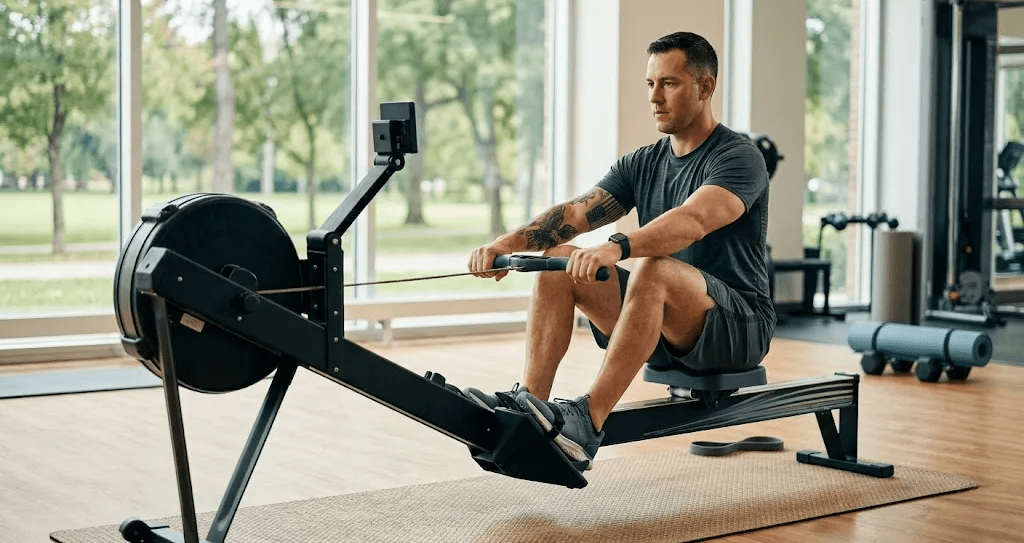
You can begin building your aerobic foundation with low-impact activities like swimming, cycling, rowing, and moderate-paced rucking.These improve your cardiovascular system and connective tissue without the repetitive strain of jogging. In particular, rucking is a natural bridge for veterans since it is efficient, pleasant, and far less stressful on the joints than jogging similar distances.
When you do resume running, start with a run-walk regimen and raise your volume by no more than 10% per week. That sounds slow. It is slow. It also means you’re actually running in six months instead of injured and frustrated in six weeks.
Sleep, Recovery, And The Things That Actually Make You Stronger
The training is the stimulus. The recovery is where the adaptation happens.
Most veterans are terrible at recovery. The culture doesn’t value it. Sleep was something you caught when you could. Rest days felt like weakness. Nutrition was whatever was available.
You do not need any of it right now.
Sleep is a must. Growth hormone is released here, muscle protein synthesis peaks, and the nervous system self-repairs. Seven to nine hours is not a luxury for someone training seriously it’s a requirement. If sleep is an issue, as many veterans have, that is a different discussion worth having with a medical expert.But address it. It is like attempting to fill a bathtub with the drain open when training on prolonged sleep deprivation.
Most veterans are unaware of the importance of protein. If you are recuperating from an injury or a period of inactivity, try to consume one gram of protein per pound of bodyweight each day. Distribute it throughout meals. For most people, this is the most significant dietary adjustment they can make.
Rest days are training days.The process is accelerated with mobility exercises, light stretching, active recovery walking, and a leisurely swim on days off. Regular physical therapy keeps the joints moving and the blood flowing to the places that need it, even though there are times when whole couch days are suitable.
Common Veteran Errors (And How to Prevent Them)
going too far.Three weeks of rigorous training followed by two weeks of recuperation from injuries is not progress.
It’s spinning in place. Half the intensity with consistent frequency beats full intensity with constant interruptions.
Ignoring pain signals. Discomfort from effort is fine. Sharp, joint-specific pain during a movement is your body telling you something. The military trained you to override this signal. In a training context, learn to listen to it instead.
Skipping the warm-up. A body that has been through military service does not warm up like a 22-year-old with fresh joints. Ten to fifteen minutes of deliberate warm-up not just walking on a treadmill is the difference between a productive session and an injury.
Chasing old numbers. What you could do at peak fitness during service is not a useful baseline for where you are now. Using it as a comparison will either push you into injury or demoralize you into quitting. Start from where you are, not where you were.
training on one’s own without responsibility. A structured program, a training partner, or a coach significantly increases adherence and lowers the chance of reverting to negative behaviors. This does not have to be done alone, and doing it alone is frequently less successful anyhow.A coach, training partner, or organized program greatly improves adherence and reduces the likelihood of returning to harmful behaviors. It is not necessary to accomplish this alone, and it is usually less successful anyhow.
A Note On The Mental Side
Rebuilding physical fitness after service isn’t just physical.
For many veterans, identity is strongly associated with strength and expertise. It may feel like more than simply a physical setback when the body refuses to obey, such as when the knees will not run, the shoulder will not press, or weariness hits harder than it used to. You may feel as though a part of your identity is disappearing.
That feeling is real and worthy of acknowledgment.
It is also true that the strength you developed while serving others did not vanish. You still have the capacity to put in a lot of effort, perform well under pressure, and have the self-control to show up when you do not feel like it. They simply need to be rerouted into a different type of conflict: the protracted one that takes decades to resolve, where the objective is to maintain good movement while your grandchildren are outpacing everyone else’s grandparents.
That fight is worth showing up for.
Where To Start Tomorrow
Here’s the easiest place to start if you have read this far and are prepared to take action:
This week, schedule a visit with a physical therapist.Obtain the evaluation.Find out what you’re actually working with.
While you wait for that appointment, walk. Thirty minutes a day, moderate pace, consistent. Nothing heroic. Just movement, every day, that doesn’t hurt.
When you have the assessment back and you know your starting point build from there. Slow, consistent, joint-friendly, and structured around where you want to be in ten years, not where you were ten years ago.
You need to be patient with the body you are rebuilding. You will receive more than you anticipate if you give it that.
This page does not provide medical advice; it is merely meant to be informative. Before starting any new training program, consult a trained medical expert if you have persistent pain or injuries related to your service.


Leave a Comment