PTSD And Sleep: What Veterans Need To Know And The Non-Medication Strategies That Work
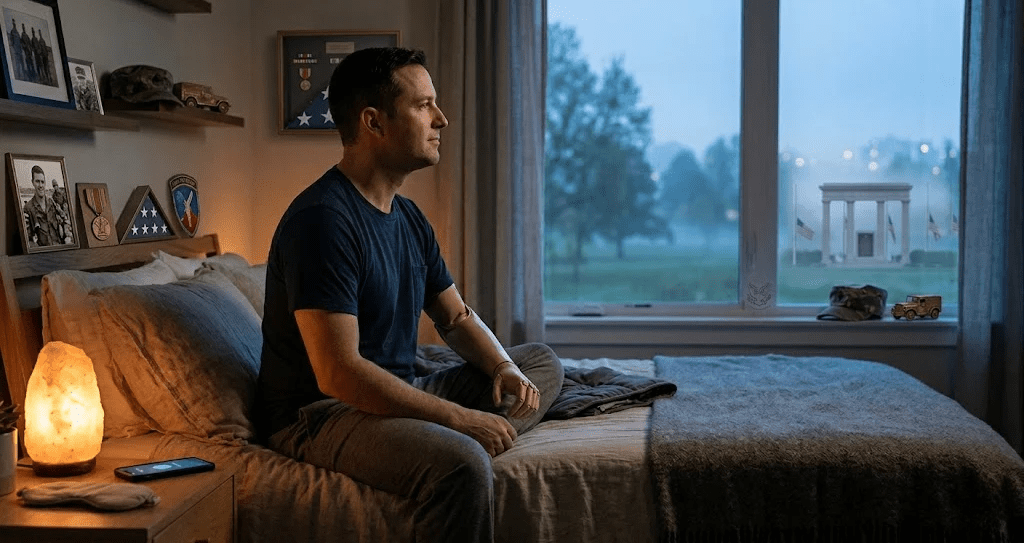
Because “just try to relax” is the worst advice anyone has ever given.
Bad sleep is almost universal among veterans with PTSD. Not “I stayed up too late” bad sleep. The kind where you finally fall asleep and wish you hadn’t. Your nervous system remains active during the night due to nightmares and hypervigilance. Your pulse rate is already high when you wake up at 0300, and you have no idea why.
You are not broken if you recognize that. Your neurological system has been rewired by experiences that most people will never have. The first step to actually taking action is to comprehend why that occurs.
What PTSD Does To Sleep (And Why)
PTSD doesn’t just cause bad dreams. The architecture of sleep itself is profoundly disrupted.
The brain’s threat-detection system centered in the amygdala stays elevated in PTSD. It doesn’t clock out when you do. REM sleep, the stage where emotional memory processing happens, becomes a problem because that’s also when the brain revisits unresolved experiences. For a nervous system carrying trauma, REM can feel less like rest and more like a replay reel you didn’t ask for.
The result: fragmented sleep, reduced deep sleep, early waking, and the kind of chronic exhaustion that compounds everything else PTSD throws at you.
Strategies That Actually Work
Image Rehearsal Therapy (IRT)
The majority of veterans are unaware of one of the most well studied non-pharmacological methods for reducing nightmares.
Rewriting the nightmare while you are awake is the concept. You take the recurrent dream, alter its conclusion or content to something neutral or even good, and deliberately practice the new version by writing it down, reading it, and spending a short period of time each day visualizing it.
It sounds too simple. The research says it works. Multiple clinical trials have shown significant reduction in nightmare frequency and intensity. It takes a few weeks of consistency, but it doesn’t require medication, a therapist’s office, or anything except about ten minutes a day.
Sleep Restriction Therapy
Contrary to conventional opinion, if you spend eight hours in bed but only receive four hours of sleep, your bed has come to represent unrest and irritation rather than slumber.
Through sleep restriction, your sleep window is briefly constricted to match your actual sleep period, and it progressively expands as your sleep quality improves. It rebuilds the association between bed and sleep that insomnia erodes. Done properly ideally with guidance from a therapist trained in CBT-I (Cognitive Behavioral Therapy for Insomnia) it produces durable results that medication.
Control The Environment
Because their environment activates their threat-detection system, hypervigilant veterans often struggle to fall asleep. Realistic changes that have a significant impact:
Verify if the door is visible from your bed. Steady noise, such as a fan or white noise, is less upsetting than quiet interspersed with random sounds. Keep the room colder than it feels since a dip in body temperature tells the brain that sleep is about to begin. Most people are unaware of the importance of blackout curtains.
This is not revolutionary at all. All of it works.
The Wind-Down Window
Your nervous system needs a transition period between operational mode and sleep. Most veterans don’t give it one going from screens, stress, or high stimulation directly to bed, then wondering why the brain won’t shut off.
Sixty to ninety minutes before bed, switch off the screens, dim the lights, and do something genuinely low-stimulus. Reading physical pages. Slow stretching. breathing techniques. Feeling drowsy is not the aim. The goal is to stop actively feeding the threat-detection system input it has to process.
Alcohol Is Not A Sleep Aid
This one needs to be said plainly because self-medicating with alcohol is extremely common among veterans with sleep problems, and it makes everything worse.
Alcohol helps you fall asleep faster and keeps you in lighter sleep stages. It suppresses REM initially, then causes REM rebound in the second half of the night which is why alcohol-disrupted sleep often involves more intense dreams in the early morning hours, not fewer. It is not treating the problem. It is rearranging it.
When To Bring In Professional Support
The strategies above are real and effective. Additionally, they should not be used in place of expert care when circumstances call for it.
Imagery Rehearsal Therapy is more effective when guided by a qualified therapist if nightmares are severe and frequent. A therapist trained in CBT-I will yield greater results than self-directed attempts if the insomnia is severe and persistent. Therapy, especially Prolonged Exposure or Cognitive Processing Therapy, tackles the underlying cause of PTSD in ways that sleep techniques alone cannot if it is seriously interfering with day-to-day functioning.
In recent years, the VA has greatly increased access to telemedicine and in-person mental health care. The Veterans Crisis Line (dial 988, then press 1) can help connect you to resources even if you are not in a crisis if navigating that system seems like a barrier in and of itself.
One Last Thing
The other PTSD symptoms are made worse by sleep deprivation. Irritability, hypervigilance, emotional reactivity, and attention are all increased by running for four interrupted hours each night.
Which means improving sleep, even incrementally, has a compounding effect on everything else. It’s not a secondary issue. For a lot of veterans, it’s the place where real recovery actually starts.
You’ve operated through worse conditions than this. But you don’t have to operate through this one alone.




Leave a Comment