Kyle Carpenter: How A 21-Year-Old Shielded His Friend From A Grenade Blast
There are moments in life that define a person forever. For most of us, those moments are quiet ones. For Kyle Carpenter, it was a split second on a rooftop in Afghanistan that would change everything, and it happened before he was old enough to rent a car.
He was 21 years old. A Marine Lance Corporal deployed to one of the most dangerous regions in the world. And in November 2010, when a grenade landed near him and his fellow Marine, Nicholas Eufrazio, Carpenter didn’t freeze. He didn’t run. He threw his body on top of the grenade.
This is that story.
Who Is Kyle Carpenter?
William Kyle Carpenter was born in 1989 in Jackson, Mississippi. He grew up with a straightforward American upbringing: sports, family, and a deep sense of duty. After high school, he enlisted in the United States Marine Corps, driven by a desire to serve something bigger than himself.
By 2010, he was deployed to Helmand Province, Afghanistan, as part of the 2nd Battalion, 9th Marines. Helmand at that time was one of the most heavily contested areas in the entire war. Marines stationed there faced daily threats from insurgents, IEDs, and constant firefights.
Carpenter was young. But he was exactly where he had chosen to be.
The Day On The Rooftop: November 21, 2010
On November 21, 2010, Carpenter and Lance Corporal Nicholas Eufrazio were manning a rooftop post in the Now Zad district of Helmand Province. Their mission was routine security. What happened next was anything but routine.
A grenade was thrown onto the rooftop.
In the fraction of a second that followed, Kyle Carpenter made a choice. He pushed his body over the grenade, placing himself between the blast and his fellow Marine.
The explosion tore through him. Carpenter suffered catastrophic injuries, including shattered bones in his face and arm, a collapsed lung, and severe damage to much of his body. Doctors who treated him said they were stunned he survived at all. His friend Eufrazio was also injured but survived.
Carpenter spent nearly three years recovering at Walter Reed National Military Medical Center. He underwent more than 40 surgeries. He had to relearn how to walk, talk, and eat. The road back was brutal, but he walked it.
The Courage Behind The Action
People often ask what goes through a person’s mind in a moment like that. Carpenter himself has spoken about it openly in interviews and in his memoir. He didn’t think. He acted. The instinct to protect someone beside him was stronger than the instinct for self-preservation.
That kind of selflessness doesn’t come from nowhere. It is built over years of training, brotherhood, and a belief that the person next to you matters. Marines train for exactly this culture: no one gets left behind, and your fellow Marine’s life is worth your own.
Carpenter has compared moments of sacrifice to a deeper human need to protect those we care about. And in that way, his story echoes the experiences of other extraordinary individuals who pushed past every limit of fear and pain. The story of Louis Zamperini, for example, shows that same refusal to give up in the face of impossible circumstances, a reminder that the human spirit, when tested, can reach heights most of us never imagined.
The Medal Of Honor: A Nation’s Highest Recognition
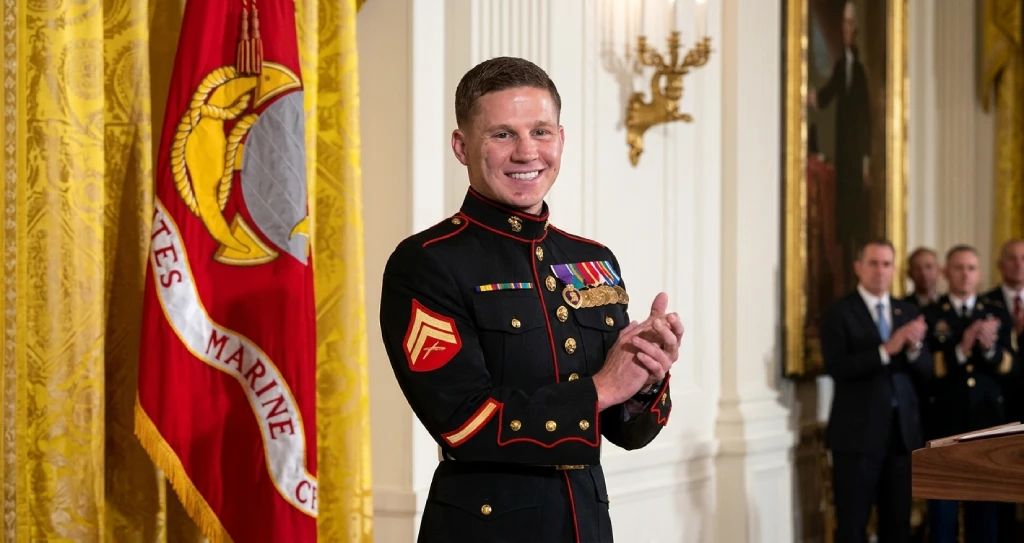
On June 19, 2014, President Barack Obama presented Kyle Carpenter with the Medal of Honor at the White House. Carpenter was 24 years old at the time, making him the youngest living recipient of the nation’s highest military honor.
The Medal of Honor is awarded for acts of valor that go above and beyond the call of duty. Of the millions who have served in the U.S. military, only a few thousand have ever received it. Kyle Carpenter’s name now belongs to that list permanently.
At the ceremony, President Obama called him “one of our nation’s most decorated warriors.” Carpenter stood at the podium, visibly moved, and spoke about his fellow Marines and the friends who had fought beside him.
He didn’t see himself as a hero. He saw himself as a Marine who did what Marines do.
Life After The Blast
Recovery was not a straight line for Carpenter. There were surgeries, pain, and moments of doubt that he has spoken about honestly. But he also enrolled at the University of South Carolina, graduated with a degree in International Studies, and became a motivational speaker, author, and advocate for veterans.
His memoir, You Are Worth It, was published in 2019. In it, he reflects on survival, purpose, and what it means to live fully after facing death. The book became a bestseller and connected with readers far beyond the military community.
He has also worked with nonprofits and organizations that support wounded warriors, turning his own trauma into fuel for helping others.
FAQ’s
Q: What did Kyle Carpenter do to earn the Medal of Honor? He threw himself on a grenade during combat operations in Helmand Province, Afghanistan in 2010 to shield his fellow Marine from the blast.
Q: Did Kyle Carpenter’s fellow Marine survive? Yes. Lance Corporal Nicholas Eufrazio was injured but survived. Kyle Carpenter’s actions are widely credited with saving his life or significantly reducing his injuries.
Q: How badly was Kyle Carpenter injured? He sustained life-threatening injuries including a collapsed lung, shattered jaw, broken arm, and extensive damage to much of his body. He underwent more than 40 surgeries during a nearly three-year recovery.
Q: How old was Kyle Carpenter when he received the Medal of Honor? He was 24 years old when President Obama presented him with the Medal of Honor on June 19, 2014, making him the youngest living recipient at the time.
Q: What has Kyle Carpenter done since leaving the military? He earned a college degree, wrote a bestselling memoir (You Are Worth It), and became a motivational speaker and veterans advocate.
A Story That Deserves to Be Told
Kyle Carpenter’s story isn’t just a war story. It’s a story about what people are capable of when they stop thinking about themselves and start thinking about someone else. It happened in a single second on a rooftop half a world away, and it rippled forward into a life rebuilt with purpose, grit, and genuine meaning.
If his story moved you, share it. Talk about it. Because stories like this remind us what courage actually looks like: not in movies, but in real life, on a dusty rooftop, in the blink of an eye.

Leave a Comment