Melvin Morris: His Medal Of Honor Came 44 Years Late But His Bravery Never Waited
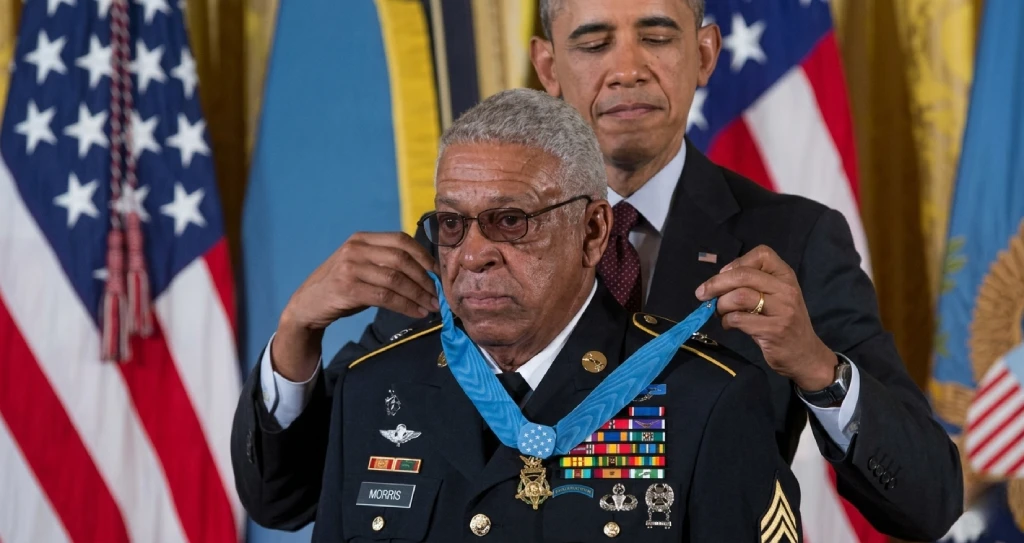
There is a certain kind of soldier who does not fight for ribbons or ceremonies. He fights because someone needs him to. Melvin Morris was that kind of soldier.
On a September afternoon in 1969, deep inside a Vietnam War combat zone near Chi Lang, Morris did something that most trained soldiers would not have attempted. He walked into enemy fire. On purpose. Three times wounded. Still moving. He came back carrying a fallen teammate on his shoulders.
The country he served eventually gave him its highest military honor. But it took 44 years to get there, and the delay was not an accident.
A Kid From Okmulgee Who Chose A Different Life
Melvin Morris was born on January 7, 1942, in Okmulgee, Oklahoma. It was a small town. Work was scarce, opportunities were scarcer, and for a young Black man growing up in 1950s America, the ceiling was not hard to find. His first job paid 65 cents an hour at a bowling alley. He knew that was not going to be his story.
In 1959, at just 17, he walked into the Oklahoma Army National Guard. One year later he transferred to active duty. From there, he pushed himself into one of the most demanding training pipelines in the entire U.S. military. In 1961, Morris earned his Green Beret, becoming one of the very first African American soldiers to do so. That distinction alone should have signaled the kind of man the Army was dealing with.
He volunteered for Vietnam once. Then I volunteered again. That tells you the rest.
September 17, 1969: Four Bunkers, Three Wounds, One Mission
Morris was commanding a Special Forces strike team near Chi Lang when the afternoon turned. His unit came across a large hidden cache of enemy weapons and supplies smuggled in from Cambodia. Before they could act, North Vietnamese troops opened fire.
During the chaos, word came over the radio. Another team commander was down, killed near an enemy bunker. His body was still out there.
Morris did not call for air support. He did not wait. He pulled together two volunteers, split off from the main force, and moved toward the bunker.
The enemy noticed.
Machine gun fire concentrated directly on his three-man group. Both soldiers with him went down, wounded. Morris was now alone in the open. The bunkers were still active. The body was still unretrieved.
He threw grenades. He moved forward. He cleared one bunker, then another, then a third, then a fourth. By the time he reached the fallen team commander, he had already taken three bullets himself. He recovered the body, turned around, and carried his comrade back through the same ground he had just fought through.
He made it. They both did.
The words he used later to describe his thinking that day were simple: “You don’t leave a soldier behind.”
The Award That Did Not Fit The Action
For what happened that afternoon, Morris received the Distinguished Service Cross. The second-highest military decoration in the United States. It was a recognition, and not a small one. But those who examined his actions years later concluded it was the wrong award.
The truth is that racial bias shaped military award decisions across multiple wars. This was not a secret. It was a pattern. A congressionally-mandated review, authorized through the Defense Authorization Act, was launched to examine cases involving minority veterans from World War II, Korea, and Vietnam. Reviewers went through more than 6,500 files. They found 24 veterans who deserved more than what they had been given.
Morris was among them.
His case is not entirely alone in American military history. Veterans who served with full commitment and waited decades for proper recognition appear across generations. Stories like that of Louis Zamperini remind us how many men returned from war carrying far more than what the official record ever reflected.
March 18, 2014: The White House, 44 Years Later
On that Tuesday morning, President Barack Obama stood before 24 veterans and their families in the East Room of the White House. The event, known as the Valor 24 ceremony, was not just about medals. It was about correction.
When the Medal of Honor was placed around Morris’s neck, he was 72 years old.
He later said he could not quite describe what he felt. But he also said something more important: “I didn’t ever question it. I went back into combat for another year, having the Distinguished Service Cross.”
No bitterness. No speech about injustice. Just a veteran who understood his own record, regardless of what any ceremony confirmed or delayed.
What He Did With The Recognition
Morris did not retire into the background after 2014. He started talking. To students, communities, veterans, and anyone willing to listen. He reflected on soldiers from entirely different eras who faced the same delayed justice. He visited Morris Island in South Carolina, where Civil War soldier William Carney had carried a Union flag through withering fire during the assault on Fort Wagner in 1863. Carney received his own Medal of Honor 37 years after that action.
The comparison was not lost on Morris. Two Black soldiers. Two different centuries. Two countries that needed time to catch up.
Bravery Does Not Have An Expiration Date
The most important thing about Melvin Morris is not the medal itself. It is the gap between what he did in 1969 and what he allowed that to define in him. He went back to combat. He kept serving. He retired as a Sergeant First Class. He settled in Brevard County, Florida with his family. He built a life.
The recognition mattered. But it did not complete him, because he had never been waiting for it.
That is the kind of courage that no ceremony can fully capture. The kind that does not require an audience. The kind that crosses a minefield because someone on the other side needs to come home.
Leave a Comment