Nick Rowe: Escaped After Five Years In A Vietnamese Prison Camp And Came Back To Serve Again
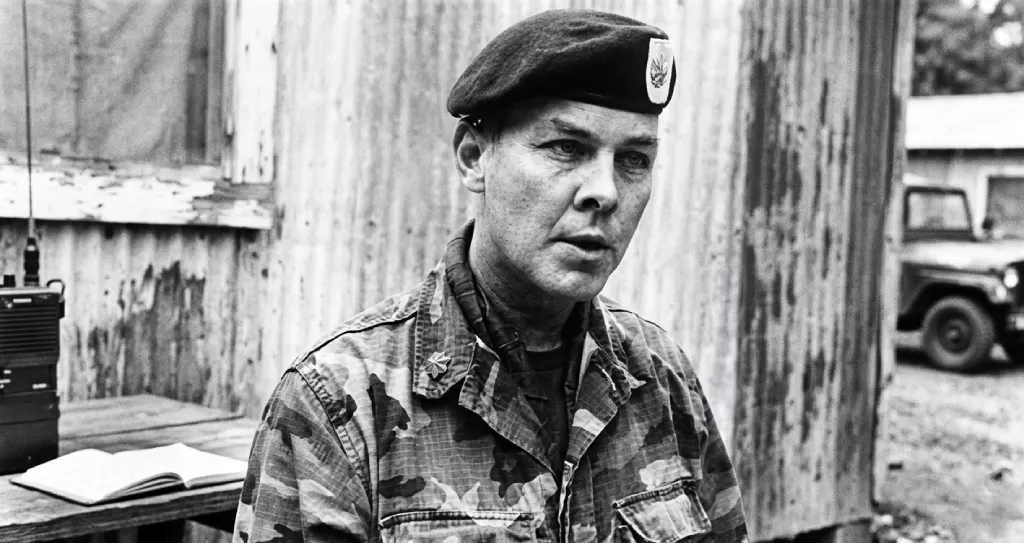
He spent 1,905 days in a bamboo cage. Most men would have never looked back. Nick Rowe went straight back to the uniform.
A Name That Deserves To Be Remembered
When people talk about Vietnam War veterans, the conversations usually drift toward protest marches, political fallout, or broad statistics. Rarely do they settle on a single soldier’s story long enough to understand what extraordinary actually looks like.
James “Nick” Rowe’s story is different. It’s the kind of story that stops you cold, makes you question what you’re really made of, and leaves you with a quiet, lasting respect for what human willpower can endure.
He was captured in 1963, survived more than five years as a prisoner of war in the swamps of South Vietnam, made a daring escape, and then, instead of walking away from military service, he came back. He kept serving. He trained hundreds of other soldiers to survive what he had survived.
That choice, the decision to return, is what makes Nick Rowe’s story more than just a survival narrative.
Captured In The Delta: October 1963
Nick Rowe was a 24-year-old Army Special Forces lieutenant when he was captured during a battle in the Mekong Delta on October 29, 1963. He had been in-country for less than a year.
The ambush was devastating. Rowe and two other American advisors were taken prisoner by Viet Cong forces. His fellow Americans, Captain Rocky Versace and Sergeant Kenneth Roraback, did not survive captivity. Rowe did, but what kept him alive was not luck alone.
From the start, Rowe understood something critical: his captors wanted information and propaganda. So he lied. He told them he was a low-level engineer with no combat knowledge. For years, he maintained that cover story, understanding that the moment his real background as a Special Forces officer was confirmed, his value as a prisoner would shift in a dangerous direction.
It was one of the most sustained acts of psychological resistance in American POW history.
Life In The Cage: What Five Years Actually Means
The conditions Rowe endured are almost impossible to picture if you haven’t read his account directly. The prison was not a formal facility. It was a series of crude cages and makeshift camps hidden deep in the U Minh Forest, a dense, mosquito-heavy swamp region in the southernmost part of Vietnam.
Rowe suffered from dysentery, skin diseases, and severe malnutrition. He watched fellow prisoners die. He was subjected to repeated interrogations, psychological manipulation, and political indoctrination sessions that the Viet Cong used as a tool to break Western captives.
What kept him intact, both mentally and physically, was discipline. He exercised in the tiny space of his cage. He maintained mental routines. He held onto his sense of identity. He refused to let the situation define who he was.
Psychologists who have studied POW survival consistently point to this kind of internal structure as the difference between those who survive and those who do not. Rowe seemed to understand this instinctively.
The Escape: December 31, 1968
After more than five years, Rowe’s cover story began to unravel. His captors had obtained documents that revealed his actual background. He was told he would be executed.
On December 31, 1968, during an American air assault in the area, Rowe managed to break free from his guards and dash toward a helicopter. He was spotted, recognized by the aircrew, and pulled to safety.
He had been a prisoner for 1,905 days.
Upon returning to the United States, he was one of only 34 American prisoners known to have escaped from the Viet Cong during the entire war.
The Choice To Return
Here is where most stories would end. Man survives impossible ordeal. Man goes home. Man heals.
Nick Rowe went back to work.
After recovery and debriefing, he rejoined the Army. He used everything he had learned, not just the tactics for physical survival but the mental framework that had kept him functional through years of captivity, and he built it into something others could use.
He became a key figure in developing the U.S. military’s SERE program, which stands for Survival, Evasion, Resistance, and Escape. The training he helped shape has been used to prepare thousands of American service members for the possibility of capture, giving them the psychological and practical tools to endure.
This is the part of his legacy that is often undersold. Yes, the escape is remarkable. But the decision to take that experience and transform it into a training framework for the next generation of soldiers, that was a different kind of courage entirely.
Serving To The End
Nick Rowe continued serving in the Army, eventually rising to the rank of colonel. By the late 1980s, he was assigned to the Philippines as part of a joint military advisory mission, helping train Filipino counterinsurgency forces.
On April 21, 1989, Colonel Nick Rowe was assassinated in Manila. A communist guerrilla organization claimed responsibility.
He was 51 years old.
The military community lost one of its most experienced voices on resilience, survival, and soldier preparation. The country lost a man who had every reason to walk away from service and chose, repeatedly, to stay.
What His Story Teaches Us
Rowe’s experience carries lessons that reach far beyond the battlefield.
Resilience is built, not given. Rowe did not have some supernatural ability to absorb suffering. He built mental habits, routines, and frameworks that kept him functional when everything around him was designed to break him down.
Identity is a form of armor. Maintaining his cover story was not just tactical. It was a way of holding onto who he was. When captors try to strip away a person’s identity, the act of remembering and protecting that identity becomes resistance in itself.
Survival is not the end goal. Rowe’s return to service is the most instructive part of his story. He did not treat survival as the finish line. He treated it as preparation for what came next. That mindset, of always orienting toward purpose and contribution rather than simply getting through, is something worth sitting with.
Stories Of Service Worth Knowing
The thread that runs through military history is not just sacrifice. It is choice. People like Nick Rowe, who had every reason to step back and instead stepped forward, define what service really means.
If you find this kind of story meaningful, the story of Captain Jennifer Moreno is worth your time. Another soldier who faced impossible circumstances and whose life reflects what commitment to duty looks like in its most honest form.
FAQ’s
How long was Nick Rowe held as a POW in Vietnam? Nick Rowe was held for approximately five years and two months, from October 1963 to December 1968, a total of 1,905 days.
How did Nick Rowe escape from the Viet Cong? During a U.S. air assault operation on December 31, 1968, Rowe broke free from his guards and ran toward a helicopter. He was recognized and rescued by the aircrew.
What was Nick Rowe’s role in SERE training? After his captivity, Rowe used his firsthand experience to help develop and shape the U.S. military’s SERE (Survival, Evasion, Resistance, and Escape) program, which trains service members to handle capture and resist enemy interrogation.
How did Nick Rowe die? Colonel Nick Rowe was assassinated in Manila, Philippines, on April 21, 1989. A communist insurgent group known as the New People’s Army claimed responsibility.
What did Nick Rowe write about his experience? Rowe authored “Five Years to Freedom,” a detailed memoir of his captivity and escape that remains one of the most respected firsthand accounts of POW survival in American military literature.
What rank did Nick Rowe hold when he was captured? Rowe was a First Lieutenant in the U.S. Army Special Forces when he was captured in 1963.
Final Thought
Nick Rowe’s story does not fit neatly into a headline. It is not simply a survival story or a war story or a tragedy. It is all of those things at once, wrapped around a man who believed that what he learned in the worst conditions imaginable was worth passing on.
There is something quietly profound about a person who endures what he endured and then turns around and says, “Now let me show others how to do this too.”
That is the mark of someone who understood service in the truest sense of the word.
Explore more stories of extraordinary military service at Veteran Diaries and share this article with someone who should know Nick Rowe’s name.
Leave a Comment